Keeping fleet employees safe in winter requires more than preparing the vehicles. Drivers, technicians, delivery employees and field crews regularly step out of their vehicles onto icy parking lots, loading areas, sidewalks and job sites.
That makes ice cleats for fleet safety an important part of a winter slip-and-fall prevention program.But fleet employees have different needs than workers who spend their entire shift outdoors. Because they frequently move between vehicles, buildings and outdoor surfaces, their ice cleats need to provide winter traction without getting in the way of the rest of the job.
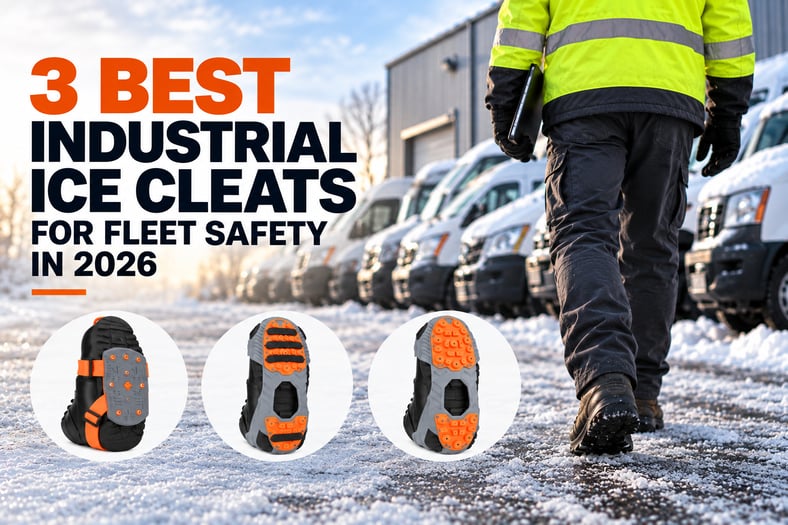
Here are three industrial ice cleats to consider for fleet employees in 2026.
What Should Fleet Managers Look for in Ice Cleats?
The most aggressive ice cleat isn't always the right ice cleat. Fleet employees may encounter ice and snow throughout the day, but they also need to drive, enter facilities, make deliveries and move between different walking surfaces.
For these employees, safety managers should consider:
- Driving requirements: Will employees need to operate vehicles while wearing their ice cleats?
- Indoor/outdoor transitions: How often do employees enter buildings during a shift?
- Winter exposure: Are employees outside for a few minutes at a time or working outdoors for extended periods?
- Footwear: Are employees wearing work boots, safety footwear or other types of shoes?
- Ease of use: Can employees easily put on, remove and properly wear the ice cleats?
- Work environment: What types of icy, snowy and indoor surfaces will employees encounter?
For employees who frequently drive or transition between indoor and outdoor environments, Winter Walking developed its Transitional Traction® category. These ice cleats provide indoor/outdoor traction for jobs where employees regularly move between different environments.
1. ICE-BREAKER™ with Transitional Traction®
 For organizations outfitting a large fleet, simplicity can make a major difference.
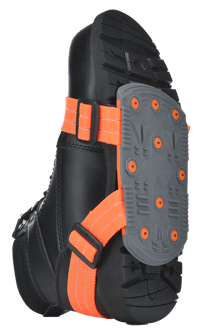
The ICE-BREAKER™ with Transitional Traction® is a one-size-fits-all industrial ice cleat designed for employees who encounter winter conditions while also transitioning between different work environments.
Adjustable toe and heel straps allow the ICE-BREAKER™ to fit a wide range of employee footwear, including sneakers and work boots. At approximately 6.5 inches long by 3.75 inches wide, it also provides substantially more underfoot coverage than traditional single-strap, one-size ice cleats.
Its molded-in tungsten carbide studs provide winter traction, while the Transitional Traction® design makes it appropriate for employees who need to drive or temporarily transition indoors during the workday.
Why it works well for fleets
-
One size simplifies distribution.
Organizations with hundreds or thousands of drivers don't need to manage an extensive size inventory. -
High-visibility orange makes identification easier.
Orange straps identify the ice cleat as part of Winter Walking's Transitional Traction® category and make it easier to recognize during safety checks. -
Designed around changing environments.
It is particularly suited to employees who repeatedly move from a vehicle to icy outdoor surfaces and into buildings. -
Easy to issue across a workforce.
Adjustable straps and broad footwear compatibility make it a practical choice for large-scale fleet programs.
For fleets looking for a straightforward ice cleat that can accommodate a wide range of employees, the ICE-BREAKER™ with Transitional Traction® is a strong place to start.
2. LOW-PRO® Ice Cleat
 Some fleet operations need a more traditional stretch-style ice cleat.
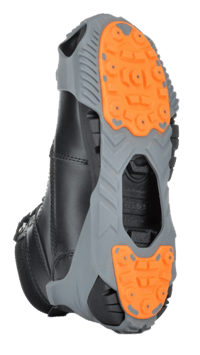
The LOW-PRO® Ice Cleat is designed for employees who intermittently move between ice and snow, indoor environments and vehicles. It uses 26 permanent tungsten carbide studs and an aggressively treaded sole to provide traction in winter conditions.
Dual rear pull-tabs help employees put the ice cleats on and take them off, while sizes from S through XXL allow organizations to match the device more closely to employee footwear.
Why it works well for fleets
Designed for indoor/outdoor work. It is part of Winter Walking's Transitional Traction® category and is intended for employees whose jobs aren't limited to outdoor environments.
-
Permanent tungsten carbide studs.
The traction components are molded into the ice cleat for industrial use. -
Aggressive tread pattern.
In addition to the studs, the sole is designed to provide additional traction in snow. -
Multiple sizes.
Fleet safety programs can select sizes based on employee footwear rather than relying on a universal fit.
The LOW-PRO® can be a good fit for drivers and field employees who need a full-foot stretch ice cleat and regularly encounter changing environments throughout their shift.
3. GRIPS-LITE® Transitional Traction®
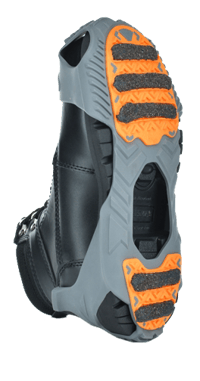 Not every fleet environment is best served by a traditional studded ice cleat. GRIPS-LITE® uses gritted traction rather than exposed metal studs. The sandpaper-like aluminum oxide grit provides additional underfoot traction while allowing employees to move between outdoor and indoor environments without repeatedly removing their traction.
The gritted design is also non-sparking and non-conductive, making it worth considering for specialized industrial fleet environments where those characteristics are important.
Why it works well for fleets
-
Gritted traction.
GRIPS-LITE® provides an alternative to traditional studded traction. -
Indoor/outdoor versatility.
It is designed for employees who need to move between different environments. -
Non-sparking and non-conductive design.
These characteristics can be important in certain industrial applications. -
Designed for industrial environments.
It provides fleet safety managers with another option when the job requirements go beyond basic walking on ice and snow.
For specialized fleet applications, the work environment should always be evaluated before selecting a traction solution.
Which Ice Cleats Are Best for Your Fleet?
There isn't one ice cleat that is right for every employee in every fleet. A delivery driver making dozens of stops may have different traction requirements than a utility employee driving to a job site and then spending several hours working outdoors. That distinction matters.
Winter Walking organizes industrial ice cleats into three categories based on how employees actually work:
-
Walking Traction® is designed for employees with limited exposure to ice and snow, such as walking through parking lots or between buildings.
-
Transitional Traction® is designed for employees who frequently move between indoor and outdoor environments or drive during the workday.
-
Working Traction® provides more aggressive traction for employees who spend extended periods working outdoors on ice and snow.
For many fleet employees, Transitional Traction® is the logical category to evaluate first because driving and frequent indoor/outdoor transitions are built into the nature of the job. However, fleet safety managers should evaluate actual job duties rather than assigning the same ice cleat to every employee simply because they operate a vehicle.
Build Fleet Safety Around the Job, Not Just the Weather
A successful fleet winter safety program starts by understanding employee exposure. Ask where employees walk after leaving their vehicles. Determine how frequently they enter buildings. Consider how long they remain outdoors and whether certain positions require significantly more aggressive traction than others. The goal isn't simply to distribute ice cleats. It is to match the right type of traction to the way employees work.
Winter Walking has spent more than 40 years developing industrial ice cleats and traction solutions for workplace slip-and-fall prevention.
Not sure which ice cleats fit your fleet? Speak with a Winter Walking Product Specialist to evaluate your employees' driving, indoor/outdoor transitions and winter exposure and build a traction program around the way your fleet actually works.